
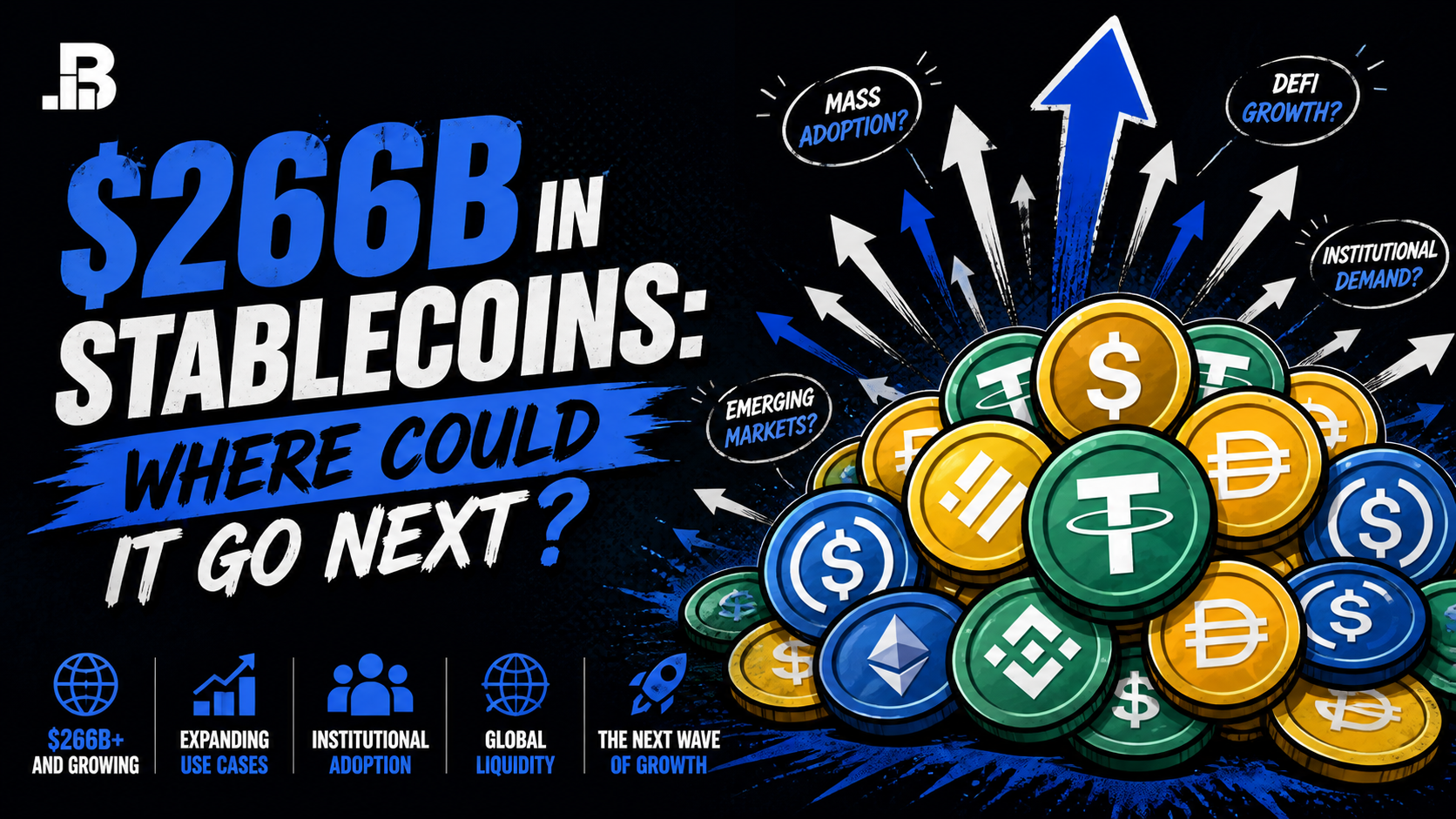
Tracking $266B in stablecoins across chains and protocols: who holds it, where it sits, and what happens when it rotates back into crypto markets.
Total stablecoin supply crossed $266B this month — an all-time high. That's the dry-powder reading the market has been waiting for. The question every desk is asking: where is it sitting, and what triggers it to deploy?
Tether (USDT) leads with roughly $151B, followed by Circle's USDC at $58B, with the remainder split across Sky's USDS, Ethena's USDe, and a long tail of newer entrants. Chain-level distribution is more concentrated than headline numbers suggest: Ethereum and Tron together hold over 80% of float, with Solana the only meaningful gainer of share over the last 12 months.
The breakdown that matters more than raw supply is the velocity profile. Tron stablecoins are predominantly used for cross-border payments and OTC settlement — that capital is sticky and rarely rotates into crypto risk assets. Ethereum stablecoins, in contrast, are heavily concentrated in DeFi vaults, CEX hot wallets, and trading desk inventory. That's the float that moves markets.
On-chain data shows roughly $80B–$90B of USDC and USDT currently sitting on centralized exchange wallets — a level that historically precedes risk-on moves of 30%+ in BTC over the following two quarters when paired with rising perp funding. Funding has been flat-to-negative for six weeks, so the catalyst hasn't fired yet.
Our base case: a Fed cut into a still-firm risk environment unlocks a meaningful share of this float. Watch USDC supply on Coinbase + Binance combined as the cleanest leading indicator. A 10%+ drawdown in that wallet aggregate inside a 30-day window has historically coincided with the start of every major altcoin run since 2021.
Put this thesis to work in a free weekly challenge.